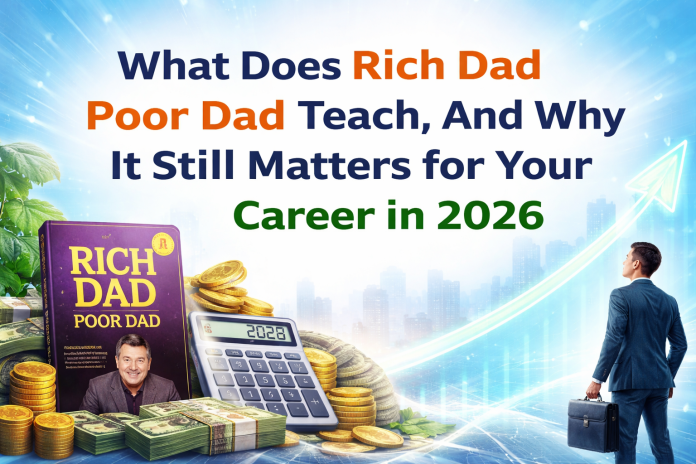


Let’s be honest. Most people didn’t read Rich Dad Poor Dad since they were obsessed with the subject of personal finance. They read it because somebody, somewhere, told them that it would transform their life. Perhaps it was a colleague who had suddenly begun to discuss assets and liabilities as though he or she had recently learnt about the existence of fire. Perhaps it was a 2am Reddit thread. It could have been just desperation because of seeing a bank balance that seemed more like a depressed mathematical equation than a savings account.
Either way, here you are. Wondering: what does Rich Dad Poor Dad teach, and does any of it come in handy in 2026?
Good news: a lot of it is. And some of it? Well, we’ll get to that too.
The Two Dads, One Very Clear Point
A comparison is established throughout the entire book by Robert Kiyosaki. His real father was his poor dad – he was educated, hard-working and always broke. His childhood friend was the son of a financially savvy man who was his rich dad.
It did not teach how education was useless. The moral was that school is not to make you a money-maker but an employee. Poor Dad said, ‘Study, get good grades, and find a safe job.’ Rich Dad has explained, learner, make money work; learn how to make money work.
That tension is exactly what Rich Dad Poor Dad is built on, and in 2026, with the job market looking like a fever dream, that tension has never felt more relevant.
The Most Important Thing the Book Actually Teaches
In the event I needed to distil what Rich Dad Poor Dad is all about into one idea, it is as follows: the rich do not work to make money; they create systems that will bring them money.
The majority of the individuals get up, sell time to get a pay cheque and continue until they are 65. According to Kiyosaki, this is the rat race. You make money, you use money, you want more money, you work more. Round and round it goes.
Assets vs. Liabilities, The Concept That Actually Slaps
The most renowned lesson taught by Rich Dad is the difference between assets and liabilities, and frankly speaking, it is excruciatingly easy to listen to.
An asset makes cash for your pocket. A liability takes money out.
That’s it. That’s the whole thing.
Your house? When you are paying a mortgage and are not earning money, then it is a liability no matter what your family dinner table argues. Your car? Liability. Your investment portfolio is an asset. A rental facility that pays for itself and even more? Asset.
The argument put forward by Kyosaki is that the middle class has spent the rest of its life incurring debts and believing that it is purchasing assets. And when you consider the financial situation of the average individual – car loans, mortgages on houses they do not own free and clear, and credit cards – it is difficult to disagree.
Financial Education Over a Fancy Degree
This is where the controversial nature of this book comes in, particularly to a career platform. Kiyosaki comes out squarely to refute the notion that earning a degree automatically equates to financial prosperity.
And lo, we are not recommending that you toss your diploma in the trash. However, the statistics in 2026 cannot be disregarded. In the US alone, the student loan debt stands at more than 1.7 trillion. The graduates in such courses as communications and fine arts, as well as certain business degrees, are finding themselves in a workforce that does not even pay them properly to cover the debt they have acquired.
What Rich Dad Poor Dad Gets Right About This in 2026
It is not about not becoming educated in the book. It is what he said about the education system; it does not teach you about money, and that is a huge gap.
Consider it – how many years of education have you spent with not a single lesson on the subject of compound interest, or tax economy, or deciphering a balance sheet? Meanwhile, a person such as Sara Blakely of Spanx grew her business to a billion dollars with only 5,000 dollars in savings and an obsessive drive to know how business and money really operate – not a textbook model.
That is the ethos of what Kiyosaki is selling.
The Mind Shift: Employee vs. Investor Mentality
Here’s where Rich Dad Poor Dad becomes truly life-altering to workaholics.
The book opens what Kiyosaki refers to as the CASHFLOW Quadrant. According to Kiyosaki, it is a more in-depth introduction in his second book, but it is introduced here. There are four categories of individuals: employees, self-employed, business owners and investors.
The majority of the population have been living in the E or S quadrant all their life, earning money. Kiyosaki claims that the rich work on the B and I quadrants, where systems and capital work hard.
How This Applies to Your Career Right Now
And this is more than ever important in the job hunt in 2026. Artificial intelligence is devouring low-level jobs. Telecommuting has levelled pay competition in the global scenario. And the layoffs of big technology firms have made it very apparent that none of the positions is truly safe in the traditional meaning of this word.
Then what does Rich Dad Poor Dad teach career people? It shows you not to make your employment your sole economic approach. Salary is not a financial plan but a stream of income. Begin to consider what you can achieve with your career. One of the side projects that has a revenue potential. An investment habit, however modest. Compounding skills as opposed to hours of trade.
Warren Buffett began investing at the age of 11. At a young age of about 30 years, he had established the base for what was to be one of the largest personal fortunes ever known to man, not necessarily because he had been making a huge salary but because he knew how to put his capital into action.
You don’t need to be Buffett. But you must no longer take your paycheque as the finish line.
The “Fear and Greed” Chapter That Nobody Talks About Enough
Among the hidden treasures of the book is the discussion Kiyosaki makes on how most people have a financial decision based on emotions, namely fear and greed.
The fear makes people continue working in the job they dislike because the salary is safe. People will waste their savings on a quick get-rich scheme or inflate their lifestyle the second time their salary increases.
He states that financial intelligence does not imply getting rid of both feelings but knowing how to handle them. Be smart enough to get over the fear. Experience the covetousness, but reason makes the judgement.
By 2026, social media will be presenting you with a highlight reel of the rich life of someone in every 5 minutes; learning to deal with greed and FOMO is truly a money-saving thing. How many individuals went into a panic-buying spurt on crypto during the late bull markets due to everyone else doing it and then lost large portions of their savings because of it? That is a classic Kiyosaki warning story being acted out in real-world scenarios.
What the Book Gets Wrong (Because We’re Being Honest Here)
No review of what Rich Dad Poor Dad teaches would be incomplete without an admission of where the book is weak, and it is weak in certain respects.
In real life, the advice given by Kiyosaki can be too simplistic. Not all of them possess capital to invest. Not all are able to leave a good salary and go to build assets. To individuals who survive on a paycheque-to-paycheque basis, the ‘just buy assets’ advice may sound tone-deaf.
His philosophy of focusing on real estate is also characteristic of a certain time and the market. The 2026 real estate market is not the same game as it used to play in the 1990s when most of his early examples were constructed. In most cities, the maths has shifted due to interest rates, affordability of houses and market saturation.
And his notoriously hostile approach to formal education has been called into question many times, by some of whom the identity of Rich Dad has been challenged, and even the autobiographical elements of the book have been challenged as well.
Borrow the philosophy and sweat the details.
The Takeaway That Actually Belongs on a Career Platform
So here’s where Moneyhasit lands on this: what does Rich Dad Poor Dad teach? It is fundamentally a change of mindset that all job hunters, career scalers and professionals require.
Your career is a tool. Your salary is a resource. It is important not to think of the job as the destination but as the fuel for creating something larger.
The way to be practical in 2026 is to spend your career income deliberately. Always invest, in whatever amount. Develop skills that are marketable beyond an employer. Consider income diversification – freelance, online products or even simple dividend-paying index funds.
Individuals that will succeed in this economy are not necessarily people with the best resumes. It is they who know where money flows and how value is made and how their working years can be used to establish the working years ahead.
That is not only personal finance advice. That’s career advice.
And honestly? This is what makes this book, the 30-year-old one, still worth reading in 2026.